Research Article | | Peer-Reviewed

Life Cycle Assessment of Painting Process: A Case for Eco-friendly Automobile Production

Received: 16 March 2025     Accepted: 14 April 2025     Published: 14 May 2025
Views:       Downloads:
Abstract

The life cycle assessment (LCA) method was introduced and applied to automotive painting process, SimaPro 9.5 software with the Swiss Ecoinvent 3 Database and the United States Life Cycle Inventory Database (USLCI), as well as ReCiPe 2016 Midpoint (H) model were used to quantitatively evaluate the impact on ecological environment of the use of materials, resources and energy as well as generated emissions and wastes through four important midpoint impact categories: climate change, ecotoxicity, human toxicity, and fossil resource scarcity, to track important environmental footprints including carbon footprint during the whole production activities of automotive painting process. In the end, the results and sensitivity analysis of the LCA research were conducted, conclusions and recommendations were given, which provided a practical industrial case for eco-friendly automobile production. Results of this study show that within the automotive painting production process, energy consumption and its resulting emissions have more significant impacts on climate change, fossil resource scarcity and human toxicity; Material consumption and its resultant emissions and wastes have a notable impact on ecotoxicity. Among the main processes and units of automotive painting production, the topcoat process has the most significant impact on all four impact categories, utility power as well as pre-treatment and electrophoresis processes follow closely. Additionally, the sealant application process exhibits a relatively significant impact on ecotoxicity. Furthermore, if the electricity used in the automotive painting production process is entirely sourced from photovoltaic power generation, compared with traditional grid power supply, the impacts on climate change, fossil resource scarcity and human toxicity would be lower, whereas the impact on ecotoxicity would be more significant.

Published in International Journal of Materials Science and Applications (Volume 14, Issue 2)
DOI 10.11648/j.ijmsa.20251402.11
Page(s) 42-52
Creative Commons

This is an Open Access article, distributed under the terms of the Creative Commons Attribution 4.0 International License (http://creativecommons.org/licenses/by/4.0/), which permits unrestricted use, distribution and reproduction in any medium or format, provided the original work is properly cited.

Copyright

Copyright © The Author(s), 2025. Published by Science Publishing Group

Keywords

Life Cycle Assessment, Automotive Painting Process, Environmental Footprint, Carbon Footprint, Midpoint Impact Category

1. Introduction
Automobile painting technology refers to the process of applying coatings onto the surface of treated white body metal parts and then curing them to form film, which mainly serves the purpose of preventing body corrosion and enhancing aesthetics. The automobile painting production process usually includes four main procedures: pre-treatment and electrophoresis (PT/ED), sealant application (PVC), topcoat painting (TC) and final inspection (including wax injection (WAX) and acoustic foaming application (AFA)), along with several sub-procedures. Due to its characteristics and strict requirements for the production environment, painting technology has become the most energy-consuming and pollutant-emitting among the four major automobile manufacturing processes. Therefore, conducting a comprehensive and systematic quantitative assessment on the impact of painting production on resources and environment, tracking and evaluating its significant environmental footprints, and identifying opportunities for environmental improvement during the production process are crucial for achieving green, low-carbon and sustainable development in automotive industry .
The standardized method for assessing environmental impacts defined by ISO 14040: 2021 "Environmental Management - Life Cycle Assessment - Principles and Framework" and ISO 14044: 2021 "Environmental Management - Life Cycle Assessment - Requirements and Guidelines", life cycle assessment (LCA), is one of the most valuable methods for analyzing environmental factors and impacts of product systems, which can be used to assess the potential environmental impacts (such as resource use and emissions) throughout the entire production process . This article takes an automobile paint shop as an example, conducting a complete life cycle assessment on the whole painting process, which is notable for its chemical and energy consumption as well as environmental impact during the vehicle manufacturing process. By tracking its significant environmental footprints, it quantitatively evaluates the impact of the use of primary materials and energy as well as the resulting wastes and emissions on the environment throughout the full lifecycle of painting process.
2. Life Cycle Assessment Method
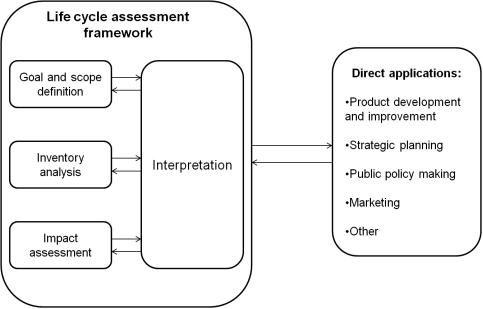
In the introduction of ISO 14040: 2021, LCA has been defined as: ‘LCA studies the environmental aspects and potential impacts throughout a product’s life (i.e. cradle-to-grave) from raw material acquisition through production, use and disposal. The general categories of environmental impacts needing consideration include resource use, human health, and ecological consequences’ . According to ISO 14040: 2021 and ISO 14044: 2021, LCA consists of four main phases (shown in Figure 1):
1. Goal and scope definition;
2. Life cycle inventory (LCI) analysis: all relevant mass flows and energy flows in the process have to be established and all material and energy inputs and outputs will be listed in the resulting inventory table ;
3. Life cycle impact assessment (LCIA): based on the results obtained from LCI analysis, inputs and outputs are sorted according to their impacts on the environment and then calculated ;
4. Interpretation: based on the goal of the study to determine impacts on human health, environment and natural resources, providing conclusions and recommendations .
Figure 1. LCA phases according to ISO 14040: 2021 .
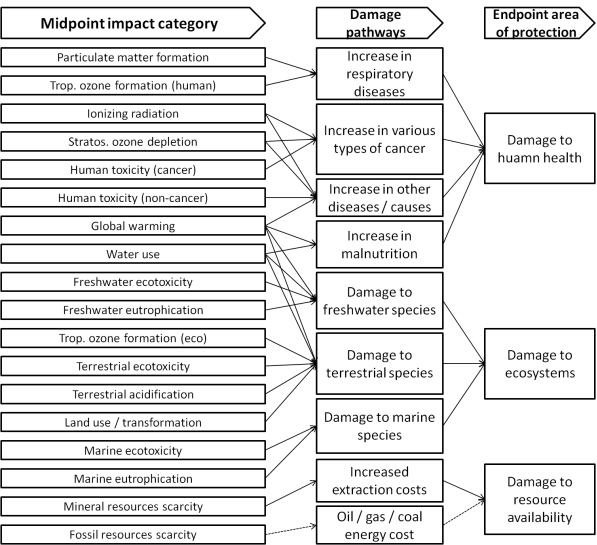
During the phase of life cycle impact assessment, the results from the inventory analysis are linked to specific environmental impact categories using characterization factors that include midpoint- (problem-oriented) and endpoint (damage-oriented) indicators. These convert numerous material and energy flows with different environmental relevancies during a product's lifecycle into a limited number of environmental impact scores to quantify these impacts and provide information required for the interpretation phase . The ReCiPe2016 impact assessment method used in this article contains a total of 18 midpoint indicators and 3 endpoint indicators (shown in Figure 2), converting life cycle inventory data into unified characterization factors . The selection of impact categories and characterization factors depends on the focus of the study. This article primarily focuses on tracking and evaluating significant environmental footprints, including carbon footprint, in the production process of automotive paint shop, thus selecting Climate Change, Ecotoxicity, Human Toxicity, and Fossil Resource Scarcity as midpoint impact categories. The aim is to investigate the damage caused by the paint shop production process to human health, ecosystems and resource availability, which also serve as the endpoint indicators chosen for this LCA study.
Figure 2. Overview of the impact categories that are covered in the ReCiPe2016 methodology and their relation to the areas of protection .
Climate Change (also known as Global Warming) mainly affects radiation forcing capability, leading to an increase in global average temperatures, ultimately harming human health as well as terrestrial and freshwater ecosystems . Since carbon dioxide is the primary greenhouse gas responsible for global warming, the Global Warming Potential (GWP) is commonly used in LCA studies to calculate the relative impact of other greenhouse gas emissions . The impact category of climate change is an important midpoint indicator to evaluate the environmental impact of the carbon footprint caused by the production process among the 18 midpoint indicators of the ReCiPe 2016 impact assessment method.
Ecotoxicity characterizes harmful changes in ecosystem structure and function at micro to macro scales caused by substances resulting from human activities . Depending on the final disposal location of waste emissions, ecotoxicity can be categorized into terrestrial ecotoxicity, freshwater ecotoxicity, and marine ecotoxicity. Ecotoxicity Potential (ETP), which includes Terrestrial Ecotoxicity Potential (TETP), Freshwater Ecotoxicity Potential (FETP), and Marine Ecotoxicity Potential (METP), is commonly used in LCA studies to calculate the relative value of the ecotoxicity impact category, with 1,4-dichlorobenzene (1,4-DCB) serving as the reference substance in midpoint indicator calculation .
Human Toxicity characterizes negative impacts on human health caused by the intake of toxic substances through air, water, and food . Given the multitude of different mechanisms that may lead to diseases or disease groups, Human Toxicity Potential (HTP), including both carcinogenic and non-carcinogenic human toxicity potential, is often used in LCA studies to calculate the relative value of the human toxicity impact category, with 1,4-dichlorobenzene (1,4-DCB) serving as the reference substance in midpoint indicator calculation .
As a crucial source of energy and raw material for many important products, fossil resources on earth are increasingly scarce. Fossil Resource Scarcity characterizes the damage associated with the scarcity of natural resources. However, different production technologies or extraction sites can influence the cost of fossil energy exploitation, therefore, Fossil Depletion Potential (FDP) is commonly used in LCA studies to calculate the relative value of the fossil resource scarcity impact category .
3. Life Cycle Assessment of Automotive Painting Process
3.1. Goal and Scope Definition
The goal of the LCA study in this article is to evaluate and compare the significant environmental impacts associated with the entire production process of a paint shop, including its main procedures and units (PT/ED, PVC, TC, WAX, AFA, and utility power). By tracking the consumption of primary materials and energy, as well as the wastes and emissions generated during these processes, this study quantitatively assesses the environmental impact of the paint shop's production process. Additionally, differences in environmental impacts due to the use of different types of electricity during the painting production process are compared through sensitivity analysis during the life cycle interpretation phase.
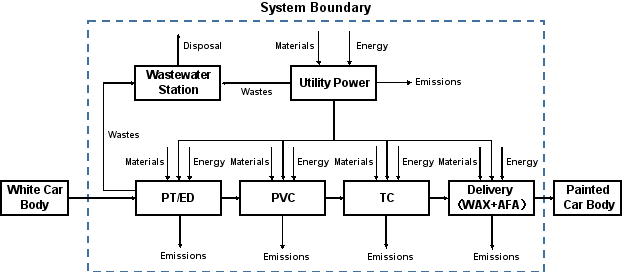
In this study, the production process of the paint shop was divided into a series of continuous unit processes that require material and energy inputs, as shown in Figure 3. All objects within the LCA boundary shown in Figure 3, including the consumption of primary materials and energy as well as emissions and waste disposal for each unit process, were included in the scope of this LCA study. According to the cut-off criteria suggested by ISO 14044: 2021 , secondary material and energy consumptions, which have relatively minor environmental impacts compared to primary ones, were considered negligible and thus excluded from the study scope. Moreover, except for wastewater which was treated to standard levels by the plant's wastewater station before discharge, other hazardous wastes produced during the painting production process are transported and treated harmlessly by specialized hazardous waste management companies. These elements fall outside the system boundary of this LCA study and therefore are not included in the research scope. As one of the value-adding processes in the automotive manufacturing industrial chain, this study adopts a gate-to-gate approach to conduct an LCA on the production process of painted car bodies, with the functional unit being a single painted car body.
Figure 3. LCA scope and boundary of the production process in the paint shop.
3.2. Inventory Analysis
In life cycle inventory analysis, to normalize LCA studies and establish a standard basis, the functional unit selected for the entire painting production process is one painted car body. All material and energy consumption as well as emission and waste data values in the inventory analysis originate from the actual production processes of this paint shop. The software tool used in this study is SimaPro 9.5, based on the Swiss Ecoinvent 3 Database and the United States Life Cycle Inventory Database (USLCI). Tables 1 and 2 summarize the material flows, energy flows, and emission/waste flows involved in the production process of a single painted car body in the paint shop, including the corresponding data providers within the software database for each type of flow. Given that this study was conducted in China, considering the practical situation of data within the software database, the scope of material and energy consumption as well as emission and waste data were chosen from China (CN), the rest of the world excluding Europe (RoW), or global (GLO) ranges.
Table 1. The input material and energy flow during the production of a single painted body in the paint shop.

Process

Material/Energy Flow

Amount

Unit

Provider

PT/ED

Accelerator

0.15

kg

Dummy_Accelerator, at plant/US

Phosphating agent

0.97

kg

Dummy_Phosphate pre-treat/kg/RNA

Cationic resin

6.21

kg

Cationic resin {RoW}| market for cationic resin | Cut-off, S

Pigment

1.08

kg

Dummy_Pigment, at plant/kg/RNA

ED solvent

0.11

kg

Solvent for paint {GLO}| market for solvent for paint | Cut-off, S

Water

1.46

t

Tap water {RoW}| market for tap water | Cut-off, S

Electricity

88.22

kWh

Electricity, medium voltage {CN}| market group for electricity, medium voltage | Cut-off, S

Natural gas

10.86

m3

Natural gas, high pressure {CN}| market for natural gas, high pressure | Cut-off, S

PVC

Sealant

12.24

kg

Polysulfide, sealing compound {GLO}| market for polysulfide, sealing compound | Cut-off, S

Electricity

36.18

kWh

Electricity, medium voltage {CN}| market group for electricity, medium voltage | Cut-off, S

Natural gas

10.02

m3

Natural gas, high pressure {CN}| market for natural gas, high pressure | Cut-off, S

TC

Base coat

4.91

kg

Alkyd paint, white, without solvent, in 60% solution state {RoW}| market for alkyd paint, white, without solvent, in 60% solution state | Cut-off, S

Clear coat

1.20

kg

Acrylic varnish, with water, in 53% solution state {RoW}| market for acrylic varnish, with water, in 53% solution state | Cut-off, S

Wash solvent

2.07

kg

Solvent, organic {GLO}| market for solvent, organic | Cut-off, S

Lime powder

9.52

kg

Quicklime, milled, loose {RoW}| market for quicklime, milled, loose | Cut-off, S

Electricity

199.17

kWh

Electricity, medium voltage {CN}| market group for electricity, medium voltage | Cut-off, S

Natural gas

31.84

m3

Natural gas, high pressure {CN}| market for natural gas, high pressure | Cut-off, S

Delivery

Cavity wax

1.79

kg

Wax, lost-wax casting {GLO}| market for wax, lost-wax casting | Cut-off, S

Wash solvent

0.13

kg

Solvent, organic {GLO}| market for solvent, organic | Cut-off, S

Isocyanates

0.80

kg

Methylene diphenyl diisocyanate {RoW}| market for methylene diphenyl diisocyanate | Cut-off, S

Polyols

1.00

kg

Polyol {RoW}| market for polyol | Cut-off, S

Electricity

27.51

kWh

Electricity, medium voltage {CN}| market group for electricity, medium voltage | Cut-off, S

Natural gas

1.47

m3

Natural gas, high pressure {CN}| market for natural gas, high pressure | Cut-off, S

Utility Power

Water

0.49

t

Tap water {RoW}| market for tap water | Cut-off, S

Electricity

224.64

kWh

Electricity, medium voltage {CN}| market group for electricity, medium voltage | Cut-off, S

Natural gas

11.87

m3

Natural gas, high pressure {CN}| market for natural gas, high pressure | Cut-off, S

Table 2. The output emission and waste flow during the production of a single painted body in the paint shop.

Process

Emission/Waste Flow

Amount

Unit

Provider

PT/ED

Carbon dioxide

21.33

kg

Carbon dioxide/low. pop.

Non-methane volatile organic compound

0.08

kg

NMVOC, non-methane volatile organic compounds, CN/ low. pop.

Wastewater

0.25

m3

Waste water

Treated wastewater

0.25

m3

Wastewater, average {RoW}| treatment of wastewater, average, wastewater treatment | Cut-off, S

PVC

Carbon dioxide

19.68

kg

Carbon dioxide/low. pop.

Non-methane volatile organic compound

0.07

kg

NMVOC, non-methane volatile organic compounds, CN/ low. pop.

TC

Carbon dioxide

62.54

kg

Carbon dioxide/low. pop.

Non-methane volatile organic compound

0.23

kg

NMVOC, non-methane volatile organic compounds, CN/ low. pop.

Delivery

Carbon dioxide

2.89

kg

Carbon dioxide/low. pop.

Non-methane volatile organic compound

0.01

kg

NMVOC, non-methane volatile organic compounds, CN/ low. pop.

Utility Power

Carbon dioxide

23.32

kg

Carbon dioxide/low. pop.

Non-methane volatile organic compound

0.09

kg

NMVOC, non-methane volatile organic compounds, CN/ low. pop.

Wastewater

0.07

m3

Waste water

Treated wastewater

0.07

m3

Wastewater, average {RoW}| treatment of wastewater, average, wastewater treatment | Cut-off, S

3.3. Impact Assessment
According to the ReCiPe 2016 impact assessment method, this study selects corresponding midpoint and endpoint indicators based on the most significant environmental categories impacted by processes within the scope of the LCA study. These indicators are used to evaluate the environmental impacts caused by the production process in the paint shop. In this study, the "ReCiPe 2016 Midpoint (H) V1.08" model was employed to calculate the values of the four critical environmental impact categories: Climate Change, Ecotoxicity, Human Toxicity, and Fossil Resource Scarcity for the following processes:
1. Production process in the paint shop with power grid supply;
2. Primary material and energy consumption as well as their respective emission and waste disposal processes during the production process in the paint shop;
3. Various main procedures and units in the paint shop;
4. Production process in the paint shop with photovoltaic power supply.
Subsequently, impact assessment and comparison were conducted for the environmental impacts caused by these processes. It should be noted that the scenario involving the use of photovoltaic power supply in the paint shop is designed to compare the environmental impacts of different power sources used in the painting production process. Assuming photovoltaic power generation (data provider: Electricity, low voltage {CN-BJ}| electricity production, photovoltaic, 3 kWp slanted-roof installation, single-Si, panel, mounted | Cut-off, S) as the sole electrical energy input for the painting production process, the entire LCA study was remodeled, recalculated and reassessed. The life cycle impact assessment results for producing a single painted car body from these different processes are shown in Tables 3 and 4.
Table 3. Results of four most dominant midpoint indicators for production of 1 painted car body in the paint shop.

Midpoint Indicator

Paint Shop with Power Grid Supply

Material Consumption & generated Emission

Energy Consumption & generated Emission

Paint Shop with Photovoltaic Power Supply

GWP/kg CO2-eq.

822.4

98.9

723.5

308.6

ETP/kg 1,4-DCB-eq.

950.1

502.4

447.7

2140.8

HTP/kg 1,4-DCB-eq.

403.3

128.5

274.8

336.8

FDP/kg oil-eq.

201.7

29.9

171.8

103.3

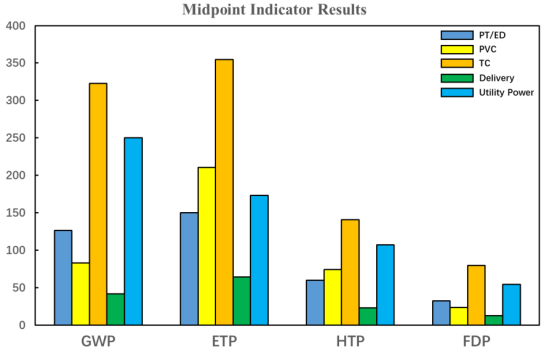
Table 4. Results of four most dominant midpoint indicators for production of 1 painted car body in each main procedure and unit.

Midpoint Indicator

PT/ED

PVC

TC

Delivery

Utility Power

GWP/kg CO2-eq.

126.2

83.0

322.6

41.4

249.9

ETP/kg 1,4-DCB-eq.

150.0

210.7

354.4

64.3

173.1

HTP/kg 1,4-DCB-eq.

59.5

74.3

140.7

22.8

106.9

FDP/kg oil-eq.

32.2

23.3

79.4

12.6

54.5

4. Results and Discussion
As the interpretation part of the LCA study, this chapter will analyze the data from sections 3.2 and 3.3 according to the rules defined in ISO 14040: 2021 and ISO 14044: 2021, compare and explain the results of the impact assessment. Furthermore, a sensitivity analysis will be conducted to compare the environmental impacts resulting from the use of different electricity sources during the painting production process. The purpose of this chapter is to verify the reliability of the inventory analysis and impact assessment. By providing an intuitive comparison of the environmental impacts generated by different processes and elements, opportunities for environmental improvement in the painting production process will be identified.
4.1. Environmental Impact of Overall Production Process in the Paint Shop
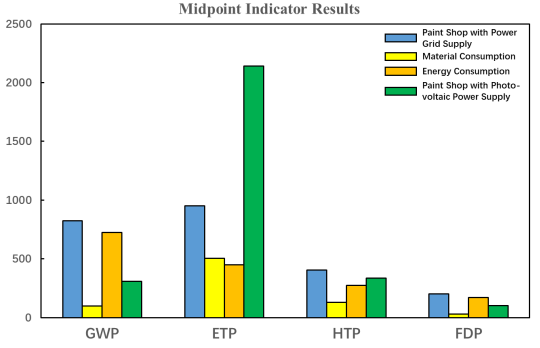
Based on the data in Table 3, the comparison of environmental impacts generated by producing a single painted car body during the overall production process in the paint shop is shown in Figure 4. As can be seen from Figure 4, energy consumption and its generated emissions contribute more to GWP, FDP and HTP than material consumption and its generated wastes and emissions. However, the contributions to ETP of both are similar. Furthermore, the production process of the paint shop with power grid supply contributes more to GWP, FDP and HTP compared to the one with photovoltaic power supply, its contribution to ETP is lower. The current power generation structure in China is predominantly based on thermal power, which consumes large amount of fossil fuels such as coal, oil and natural gas, while emitting significant amounts of greenhouse gases including CO2, CH4, N2O and CO to the environment which leads to global warming, as well as emitting significant amounts of toxic substances such as HCl, H2SO4 and HF formed from chloride, sulfur and fluoride impurities in fuel to the environment and are toxic to humans . Moreover, during the production processes in paint shop, nearly all CO2 emissions originate from the combustion of natural gas in drying ovens, utility power facilities (such as burners in air supply units), and environmental protection treatment facilities (such as incinerators in paint booth exhaust purification systems) of various processes. Consequently, the energy consumption and its generated emissions contributes significantly to GWP, FDP, HTP and ETP. During the painting production process, large amount of chemicals are used (such as paint, cleaning agents, sealants, cavity wax, foaming materials, etc.), harmful substances generated during their production and use phases are discharged into the ecological environment. Therefore, the material consumption and its generated wastes and emissions contribute significantly to ETP. Photovoltaic power generation, as a renewable clean energy source that uses solar energy, does not produce greenhouse gases or toxic substances harmful to ecological environment and humans once installed and operational. However, during the production of solar panels, large amount of chemicals such as hydrofluoric acid, nitric acid, trichloro-oxygen phosphorus and isopropanol are used, accompanied by wastewater discharge (fluoride ions, COD, total nitrogen, etc.) and exhaust gas emissions (nitrogen oxides, hydrogen fluoride, hydrogen chloride, etc.) . Consequently, compared to power grid supply, the paint shop with photovoltaic power supply has lower contributions to GWP, FDP and HTP, but a much higher contribution to ETP.
Figure 4. Comparison of the environmental impact assessment results of the overall production process of the paint shop.
4.2. Environmental Impact of Various Processes and Units in the Paint Shop
Based on the data in Table 4, Figure 5 illustrates the environmental impacts of each main process and unit involved in the production of a single painted car body in the paint shop. As shown in Figure 5, the TC process contributes most significantly to all four midpoint indicators among the major processes and units in the paint shop, followed by utility power and PT/ED, which also exhibit substantial contributions to these indicators. Notably, the PVC process demonstrates a significant contribution to ETP. As can be observed from Tables 1 and 2, the TC process, which includes the paint booth, drying oven, and paint booth exhaust purification systems, consumes considerable energy and chemicals while emitting high levels of CO₂ and VOCs, leading to its highest environmental impact among all processes and units in the paint shop. Utility power and PT/ED processes also display notable energy consumption and utilize large quantities of chemicals, generating VOCs and wastewater that are discharged into the ecological environment, thereby exerting significant environmental effects. The sealing compound used in the PVC process is harmful to the ecological environment during both its production and usage stages, explaining why the PVC process has a significant contribution to ETP.
Figure 5. Comparison of the environmental impact assessment results of the main processes and units of the paint shop.
5. Conclusions and Outlook
This article uses LCA methodology to track the environmental footprint including carbon footprint generated by the usage of primary materials and energy as well as their resultant emissions and wastes during the entire vehicle painting production process. The impacts on the environment of a single painted car body produced in the paint shop were quantitatively assessed using GWP, ETP, HTP and FDP. From this LCA study, it can be concluded that within the painting production process, energy consumption and its resulting emissions have more significant impacts on climate change, fossil resource scarcity and human toxicity. Meanwhile, material consumption and its resultant emissions and wastes have a notable impact on ecotoxicity. Among the main processes and units of painting production, the TC process has the most significant impact on all four impact categories, utility power and PT/ED processes follow closely. Additionally, the PVC process exhibits a relatively significant impact on ecotoxicity. Furthermore, if the electricity used in the painting production process is entirely sourced from photovoltaic power generation, compared with traditional grid power supply, the impacts on climate change, fossil resource scarcity and human toxicity would be lower, whereas the impact on ecotoxicity would be more significant. Therefore, in the painting production process, to mitigate the effects on climate change, fossil resource scarcity and human toxicity, it is advisable to control the consumption of electricity and natural gas, particularly for processes with higher energy consumption proportions. Moreover, there should be a strong promotion of renewable energy sources to reduce the environmental impacts caused by electricity consumption and other energy-demanding processes . To decrease the impact on ecotoxicity, controlling the usage of environmentally impactful materials (such as paint, sealant, pretreatment agents, cleaning agents etc.) and substituting them with more environmentally friendly and green alternatives should be prioritized .
While the entire vehicle manufacturing industry is concentrating on transitions towards electrification and intellectualization, the construction of green and low-carbon production workshop has become equally crucial under increasingly stringent global environmental regulations . Guided by the LCA theory, targeted energy-saving and emission-reduction measures can be implemented for paint shops and eventually extended throughout the entire automotive manufacturing industry, including upstream raw material extraction, supply chain, downstream transportation, sales, usage, and end-of-life recycling stages, establishing a cradle-to-grave life cycle assessment across the entire automotive manufacturing industry chain. Such comprehensive assessments provide advanced insights and scientific methodologies to foster green and low-carbon development within the industry. The widespread application of LCA will continuously uncover and promote more efficient, environmentally friendly and economically viable production models and manufacturing processes, which are beneficial from technical, economic, and social perspectives.
Abbreviations

LCA

Life Cycle Assessment

LCI

Life Cycle Inventory

LCIA

Life Cycle Impact Assessment

USLCI

The United States Life Cycle Inventory Database

GWP

Global Warming Potential

ETP

Ecotoxicity Potential

TETP

Terrestrial Ecotoxicity Potential

FETP

Freshwater Ecotoxicity Potential

METP

Marine Ecotoxicity Potential

HTP

Human Toxicity Potential

FDP

Fossil Depletion Potential

1,4-DCB

1,4-dichlorobenzene

COD

Chemical Oxygen Demand

CN

China

BJ

Beijing

RoW

The Rest of the World Excluding Europe

GLO

Global

PT/ED

Pre-treatment and Electrophoresis

PVC

Sealant Application

TC

Topcoat Painting

WAX

Wax Injection

AFA

Acoustic Foaming Application

Acknowledgments
Authors acknowledge the Beijing Automotive Group, and Beijing Benz Automotive Co., Ltd. for the possibility to provide this research.
Author Contributions
Wang Sicheng: Conceptualization, Data curation, Investigation, Methodology, Resources, Software, Visualization, Writing – original draft, Writing – review & editing
Liu Sumin: Funding acquisition, Project administration,
Qiu Jiajun: Supervision
Wang Daran: Validation
Funding
This work is not supported by any external funding.
Data Availability Statement
The data supporting the outcome of this research work has been reported in this manuscript.
Conflicts of Interest
The authors declare no conflicts of interest.
References
[1] European Commission. (2021). Best Available Techniques (BAT) Reference Document for Surface Treatment Using Solvents. Publications Office of the European Union. Luxembourg.
[2] International Energy Agency (IEA). (2023). Global EV Outlook 2023: Catching up with Climate Ambitions. OECD Publishing, Paris.
[3] International Organization for Standardization. (2021). ISO 14040: 2021 Environmental management — Life cycle assessment — Principles and framework.
[4] International Organization for Standardization. (2021). ISO 14044: 2021 Environmental management — Life cycle assessment — Requirements and guidelines.
[5] Laurent, A., Olsen, S. I., & Hauschild, M. Z. (2018). Life cycle assessment: Theory and practice. Springer.
[6] Jolliet, O., Antón, A., Boulay, A.-M., et al. (2018). Global guidance on environmental life cycle impact assessment indicators. International Journal of Life Cycle Assessment, 23(11), 2189–2207.
[7] Henderson, A. D., Niblick, B., & Golden, H. E. (2021). Modeling spatially resolved characterization factors for eutrophication potential in life cycle assessment. International Journal of Life Cycle Assessment, 26(9), 1832–1846.
[8] Andreasi Bassi, S., Biganzoli, F., Ferrara, N., et al. (2023). Updated characterisation and normalisation factors for the Environmental Footprint 3.1 method (JRC Technical Report No. JRC130796). Publications Office of the European Union. Luxembourg.
[9] Peng, Y., Li, X., & Zhang, Q. (2021). VOC emissions of coal-fired power plants in China based on life cycle assessment method. Fuel, 292, 120325.
[10] Wang, G. Z., Liu, Y., & Chen, R. (2024). Anticipating future photovoltaic waste generation in China: Navigating challenges and exploring prospective recycling solutions. Environmental Impact Assessment Review, 106, 107516.
[11] Usman, M., Khan, S., & Ahmad, P. (2024). Integrating renewable energy solutions in the manufacturing industry: Challenges and opportunities: A review. Engineering Science & Technology Journal, 5(3), 674–703.
[12] Paiano, A., Gallucci, T., & Pontrandolfo, A. (2021). Sustainable options for paints through a life cycle assessment method. Journal of Cleaner Production, 295, 126464.
[13] Juhl, M., Dam-Johansen, K., & Olsen, S. M. (2024). An eco-strategy for development of more sustainable coatings. Progress in Organic Coatings, 197, 108781.
[14] Ita-Nagy, D., Vázquez-Rowe, I., & Kahhat, R. (2020). Reviewing environmental life cycle impacts of biobased polymers: current trends and methodological challenges. International Journal of Life Cycle Assessment, 25, 2169–2189.
[15] Billey, A., & Wuest, T. (2024). Energy digital twins in smart manufacturing systems: A case study. Robotics and Computer-Integrated Manufacturing, 88, 102729.
Cite This Article
  • APA Style

    Sicheng, W., Sumin, L., Jiajun, Q., Daran, W. (2025). Life Cycle Assessment of Painting Process: A Case for Eco-friendly Automobile Production. International Journal of Materials Science and Applications, 14(2), 42-52. https://doi.org/10.11648/j.ijmsa.20251402.11

    Copy | Download

    ACS Style

    Sicheng, W.; Sumin, L.; Jiajun, Q.; Daran, W. Life Cycle Assessment of Painting Process: A Case for Eco-friendly Automobile Production. Int. J. Mater. Sci. Appl. 2025, 14(2), 42-52. doi: 10.11648/j.ijmsa.20251402.11

    Copy | Download

    AMA Style

    Sicheng W, Sumin L, Jiajun Q, Daran W. Life Cycle Assessment of Painting Process: A Case for Eco-friendly Automobile Production. Int J Mater Sci Appl. 2025;14(2):42-52. doi: 10.11648/j.ijmsa.20251402.11

    Copy | Download

  • @article{10.11648/j.ijmsa.20251402.11,
      author = {Wang Sicheng and Liu Sumin and Qiu Jiajun and Wang Daran},
      title = {Life Cycle Assessment of Painting Process: A Case for Eco-friendly Automobile Production
    },
      journal = {International Journal of Materials Science and Applications},
      volume = {14},
      number = {2},
      pages = {42-52},
      doi = {10.11648/j.ijmsa.20251402.11},
      url = {https://doi.org/10.11648/j.ijmsa.20251402.11},
      eprint = {https://article.sciencepublishinggroup.com/pdf/10.11648.j.ijmsa.20251402.11},
      abstract = {The life cycle assessment (LCA) method was introduced and applied to automotive painting process, SimaPro 9.5 software with the Swiss Ecoinvent 3 Database and the United States Life Cycle Inventory Database (USLCI), as well as ReCiPe 2016 Midpoint (H) model were used to quantitatively evaluate the impact on ecological environment of the use of materials, resources and energy as well as generated emissions and wastes through four important midpoint impact categories: climate change, ecotoxicity, human toxicity, and fossil resource scarcity, to track important environmental footprints including carbon footprint during the whole production activities of automotive painting process. In the end, the results and sensitivity analysis of the LCA research were conducted, conclusions and recommendations were given, which provided a practical industrial case for eco-friendly automobile production. Results of this study show that within the automotive painting production process, energy consumption and its resulting emissions have more significant impacts on climate change, fossil resource scarcity and human toxicity; Material consumption and its resultant emissions and wastes have a notable impact on ecotoxicity. Among the main processes and units of automotive painting production, the topcoat process has the most significant impact on all four impact categories, utility power as well as pre-treatment and electrophoresis processes follow closely. Additionally, the sealant application process exhibits a relatively significant impact on ecotoxicity. Furthermore, if the electricity used in the automotive painting production process is entirely sourced from photovoltaic power generation, compared with traditional grid power supply, the impacts on climate change, fossil resource scarcity and human toxicity would be lower, whereas the impact on ecotoxicity would be more significant.
    },
     year = {2025}
    }
    

    Copy | Download

  • TY  - JOUR
    T1  - Life Cycle Assessment of Painting Process: A Case for Eco-friendly Automobile Production
    
    AU  - Wang Sicheng
    AU  - Liu Sumin
    AU  - Qiu Jiajun
    AU  - Wang Daran
    Y1  - 2025/05/14
    PY  - 2025
    N1  - https://doi.org/10.11648/j.ijmsa.20251402.11
    DO  - 10.11648/j.ijmsa.20251402.11
    T2  - International Journal of Materials Science and Applications
    JF  - International Journal of Materials Science and Applications
    JO  - International Journal of Materials Science and Applications
    SP  - 42
    EP  - 52
    PB  - Science Publishing Group
    SN  - 2327-2643
    UR  - https://doi.org/10.11648/j.ijmsa.20251402.11
    AB  - The life cycle assessment (LCA) method was introduced and applied to automotive painting process, SimaPro 9.5 software with the Swiss Ecoinvent 3 Database and the United States Life Cycle Inventory Database (USLCI), as well as ReCiPe 2016 Midpoint (H) model were used to quantitatively evaluate the impact on ecological environment of the use of materials, resources and energy as well as generated emissions and wastes through four important midpoint impact categories: climate change, ecotoxicity, human toxicity, and fossil resource scarcity, to track important environmental footprints including carbon footprint during the whole production activities of automotive painting process. In the end, the results and sensitivity analysis of the LCA research were conducted, conclusions and recommendations were given, which provided a practical industrial case for eco-friendly automobile production. Results of this study show that within the automotive painting production process, energy consumption and its resulting emissions have more significant impacts on climate change, fossil resource scarcity and human toxicity; Material consumption and its resultant emissions and wastes have a notable impact on ecotoxicity. Among the main processes and units of automotive painting production, the topcoat process has the most significant impact on all four impact categories, utility power as well as pre-treatment and electrophoresis processes follow closely. Additionally, the sealant application process exhibits a relatively significant impact on ecotoxicity. Furthermore, if the electricity used in the automotive painting production process is entirely sourced from photovoltaic power generation, compared with traditional grid power supply, the impacts on climate change, fossil resource scarcity and human toxicity would be lower, whereas the impact on ecotoxicity would be more significant.
    
    VL  - 14
    IS  - 2
    ER  - 

    Copy | Download

Author Information
  • Beijing Benz Automotive Co., Ltd., Beijing Automotive Group, Beijing, China

  • Beijing Benz Automotive Co., Ltd., Beijing Automotive Group, Beijing, China

  • Beijing Benz Automotive Co., Ltd., Beijing Automotive Group, Beijing, China

  • Beijing Benz Automotive Co., Ltd., Beijing Automotive Group, Beijing, China